Two Capitals
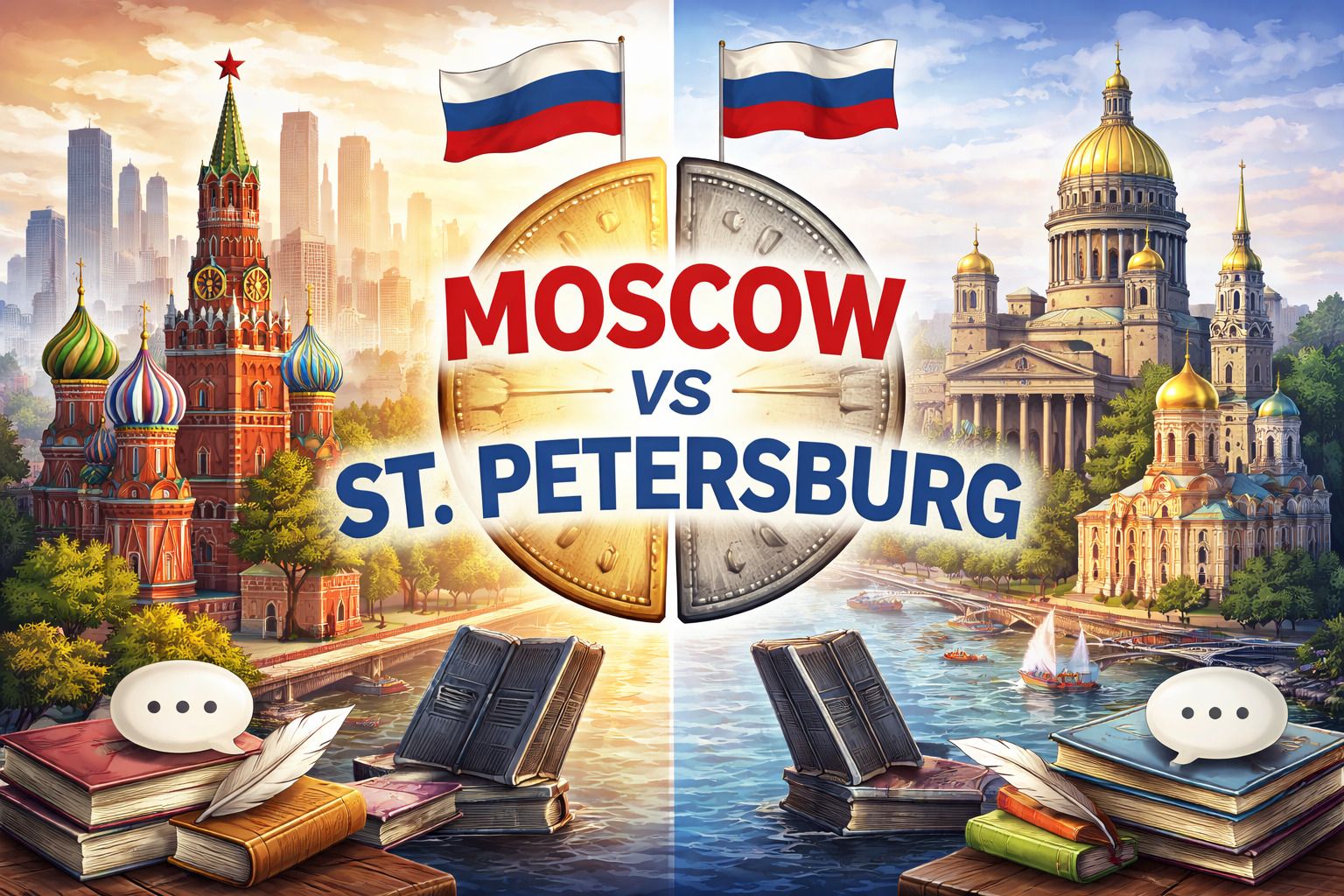
Moscow and St. Petersburg это две стороны одной медали, два города, олицетворяющих Россию (are like two sides on a coin, two cities, symbolizing Russia). Moscow is smart, active, and dynamic. St. Petersburg is a cultural, tempered city, filled with history and architectural splendor. The residents of these two capitals are completely different, as is the way of life, which, in a long-established environment, leaves an imprint on the character of their citizens.
Two Different Dialects
And the dissimilarity between the two cities doesn't end here. Манера говорить также отличает московское и петербургское сообщества (the way of speaking also confers a distinction between the community of Moscow and St. Petersburg). That is, although they share the Russian language, the way it is spoken in the two capitals is very different. Therefore, some linguists have noted the existence of так называемых, московского и петербургского говоров (the so-called Moscow and St. Petersburg dialects).
The differences consist of a number of factors: a particular accent, the use of words and their synonyms, differences in the intonation. Оба варианта произношения при этом остаются понятными подавляющему большинству жителей огромной территории Российской Федерации (both variants of the pronunciation in that case remain understandable for the vast majority of inhabitants of territory of the Russian Federation), as well as not radically different from the norms of the Russian language.

Reasons for Changes
The reasons for some discrepancies in the use of the language have to do with differences in the history of the founding of both capitals, as well as a gap in the historical timing of their formation. For example, Peter the Great had to bring countless specialized workers (architects, builders, engineers) from abroad. Russian merchants were also among the participants in the construction of the city. This community of “first builders of the city” later became the bases for the formation of an intelligent and educated population in St. Petersburg.
All the participants in the construction of St. Petersburg knew that for a successful career in the country, they needed to know its language. For foreigners, who arrived in Russia, learning the language in a natural way was impossible as they were surrounded by people of different social classes, speaking hundreds of Russian dialects. This is why, foreign visitors of the northern capital at the time turned to the written sources for the study of Russian. This is the main reason why the norm of pronunciation and the usage of words in St. Petersburg, to a greater extend, prevails in books and literary standard of Russian, and not in spoken language.
Examples
And this is how the differences between the dialects of Moscow and St. Petersburg were born. Here are a few examples:
Moscow | St. Peterburg | Translation |
| подъезд | парадная | entrance, front door |
| бордюр | поребрик | road curb |
| водолазка | бодлон | polo-neck sweater |
| проездной | карточка | travel card |
| эстакада | виадук | overpass, flyover |
| шаурма | шаверма | doner kebab |
| батон | булка | long loaf of bread |
| пончик | пышка | doughnut |
| палатка | ларёк | vendor stall |
| курица | кура | chicken |
| ластик | резинка | eraser |
| тысяча | тонна | thousand |
Юлия Соколова