Ilya Yefimovich Repin (1844–1930) was a leading Russian painter and sculptor of the Peredvizhniki school — the «передвижники», or the Wanderers. An important part of his work is dedicated to ordinary people: his realistic paintings show great psychological depth and expose the tensions within the social order of Imperial Russia.
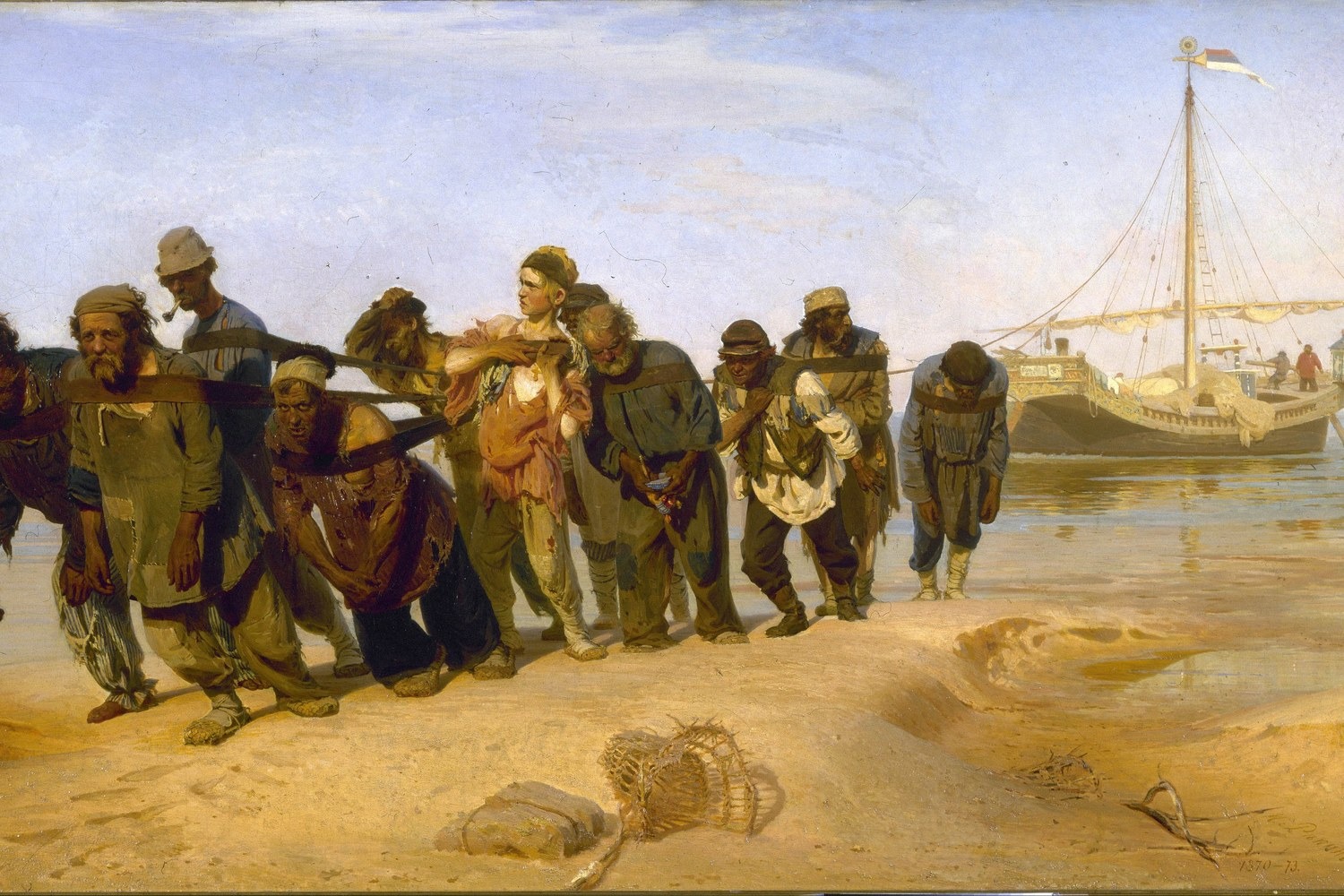
The Volga Boatmen
One day in 1870, while walking along the shores of the Neva, Repin saw a dozen exhausted men dragging a barge against the current. The distressing fate of these haulers struck him deeply. Coming from a humble family himself and knowing what labour and poverty mean, he felt the need to paint them.
For many months Repin travelled along the Volga. He watched the «бурлаки» (barge haulers) drag their «бечеву» (towline), sat with them around campfires and made dozens of drawings, trying to capture the character of each man — his strength, his effort, his exhaustion.
In 1873 Repin unveiled the painting «Бурлаки на Волге» (Barge Haulers on the Volga). Its realism made a strong impression on the public. It took great courage to portray the lives of the oppressed so truthfully in pre-revolutionary Russia.
On the canvas, eleven ragged, weather-beaten men haul a heavy barge with great difficulty. Their faces express all the misery and hardship they have been through, and it is nearly impossible to tell their age. They had been hired for this hard labour simply so as not to die of hunger.
Other paintings
Life in Imperial Russia was hard for ordinary people, and Repin always stood by those who struggled against their oppressors. His «Арест пропагандиста» (Arrest of the Propagandist) shows the contempt on the policemen's faces, while «Под конвоем» (Under Guard) depicts the long, endlessly dull road to Siberia under a grey, cold sky — the road along which a convict is taken to serve his sentence.
But despite their many burdens, people did not lose their courage and cheerfulness — and Repin depicted that too. His «Запорожцы пишут письмо турецкому султану» (Reply of the Zaporozhian Cossacks) is a very different painting: full of life, yet not a single detail of its characters is omitted.
More about Russian art and history: «The Imperial Fabergé Easter Eggs», «Dzhigitovka, the Art of Riding» and «Russian Idioms Linked with Religious Traditions». To learn Russian with us, have a look at the five levels of Russian, join our Russian courses in Moscow or sign up for private Russian lessons online — and keep reading our blog.
Image: Ilya Repin, Barge Haulers on the Volga (1870–1873), Wikimedia Commons, public domain