Russian Roulette: How Russian Is It, Really?
Few expressions sound as instantly Russian as Russian roulette. The name has travelled so far that today it is used well beyond the original meaning: in newspapers, films and everyday speech, “playing Russian roulette” can simply mean taking a reckless risk.
In Russian, the expression is русская рулетка - russkaya ruletka. The stress falls on the second syllable: руле́тка.
The curious part is that its Russian origins are much less certain than the name suggests.
A Russian story written abroad
The earliest known printed use of the English expression русская рулетка dates to 1937. It appeared in a short story by Georges Surdez in the American magazine Collier’s Weekly. In the story, a former soldier describes Russian officers taking part in a deadly game of chance during the upheaval surrounding the Russian Revolution.
Historians have not established a clear Russian custom by that name before Surdez’s story. What seems much more certain is that the expression travelled well: first through fiction and journalism, then into other languages, Russian included.
Languages often work this way. A word or expression may acquire a new meaning, pronunciation or set of associations as it moves. Russian has absorbed foreign vocabulary for centuries, sometimes preserving its origin quite visibly and sometimes making it feel entirely its own. The same process appears in words such as жалюзи, whose French origin still affects its Russian pronunciation - something we explore in Language Changes and Norms.
Why “roulette”?
The second half of the expression is not Russian either. Рулетка came into Russian from French roulette, connected with the idea of a small wheel or something that rotates.
In modern Russian, рулетка has several meanings. It can refer to the casino game, but it can also mean the retractable tape measure you might use to measure a wall or a piece of furniture. So a Russian learner may hear:
играть в рулетку - to play roulette
and then, in an entirely different situation:
измерить рулеткой - to measure something with a tape measure.
Russian is full of words whose meanings have shifted, widened or become attached to particular cultural situations. Sometimes the change happens naturally over centuries; sometimes a writer helps it along. Several everyday Russian words, for example, are closely associated with writers who introduced or popularised them - a story behind our article Russian Words Invented by Writers.
From a dangerous game to popular culture
By the second half of the twentieth century, Russian roulette no longer belonged only to stories about revolvers and chance. The phrase had become a ready-made image for any decision in which the risk felt uncomfortably high.
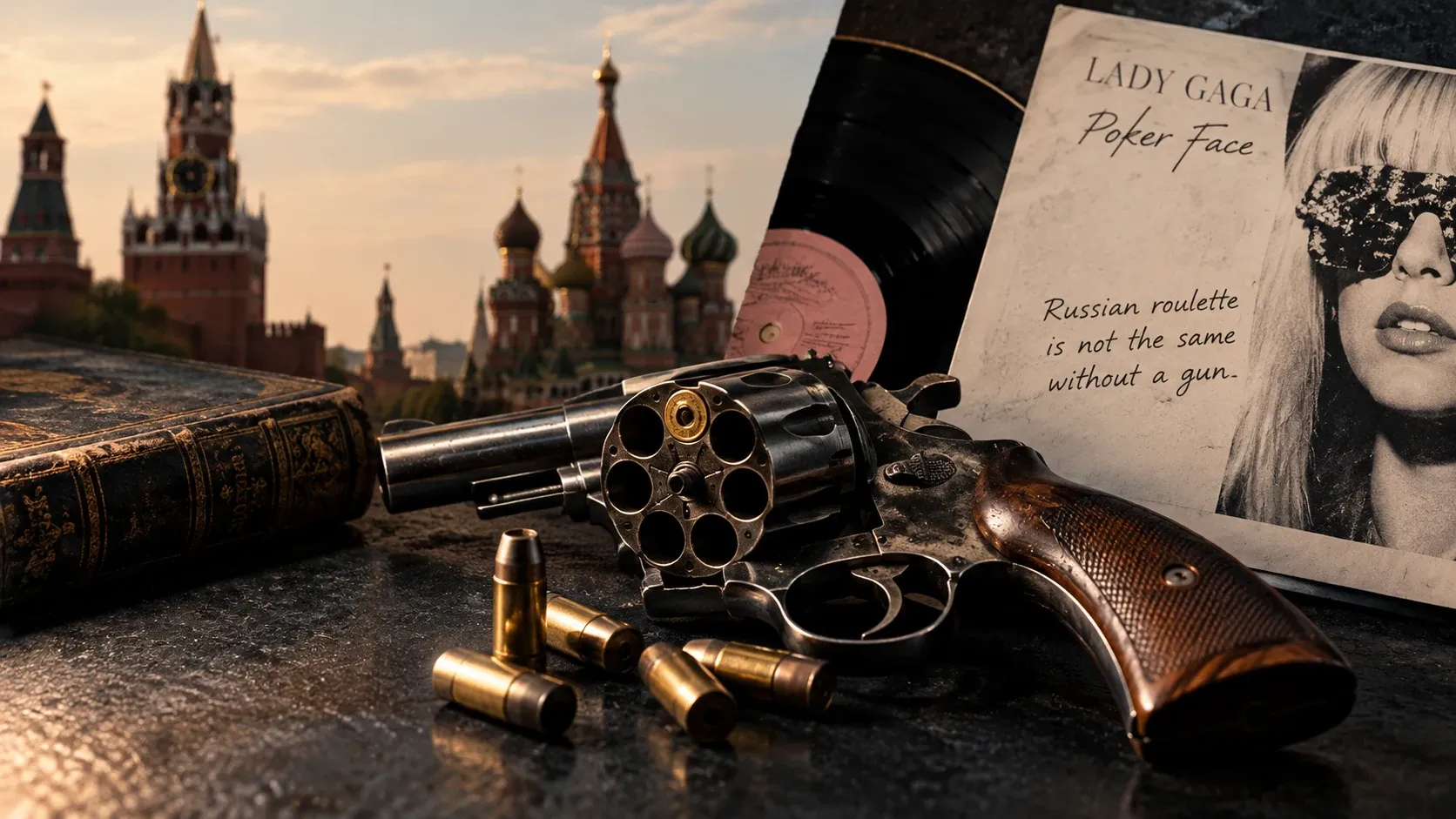
It travelled easily through newspapers, films and music. In Poker Face, Lady Gaga uses the line “Russian roulette is not the same without a gun.” Nothing around it needs explaining.
Russian uses русская рулетка in much the same way. It can still refer to the game itself, but it also appears when the subject is a dangerous gamble, an unreliable system or a choice with consequences no one can predict.
This is a familiar route for expressions. A concrete image enters literature or popular culture, then slowly detaches from the scene that created it. Russian has many phrases with similar biographies. Some came from fables and several of them are still part of everyday speech, as in our article on Krylov’s idioms.
Is it actually Russian?
The safest answer is: the expression is; the tradition is harder to prove.
Russian has fully adopted русская рулетка as a normal phrase. But the familiar story about Russian officers routinely playing it should be treated with caution rather than as established historical fact.
What remains is a rather unusual piece of vocabulary: a French-derived noun, an English-language expression and a Russian adjective, combined into something the whole world now recognises.
Russian contains plenty of these linguistic journeys. Geography can shape them too: even within Russia, the same everyday object may acquire different names in Moscow and St Petersburg - бордюр in one city, поребрик in the other; шаурма here, шаверма there. That story continues in Two Capitals, Two Languages.
A phrase such as русская рулетка is another reminder that vocabulary rarely belongs to one place forever. Words travel with books, films, fashions and people, and by the time they settle into everyday speech, their passports can be surprisingly difficult to read.